On April 30, 2026, ShinyHunters breached Instructure for the second time in eight months. The first was a social engineering attack against Instructure's Salesforce environment in September 2025. By May 7, Canvas login pages at affected schools displayed a ransom message, and Canvas, Canvas Beta, and Canvas Test were placed into maintenance mode.
Instructure confirmed that names, email addresses, student IDs, and private messages were exposed. They stated they found no indication that passwords, dates of birth, government identifiers, or financial data were compromised. ShinyHunters claims 275 million records across 8,809 institutions. That number has not been confirmed or denied by Instructure.
What we know, and what we don't
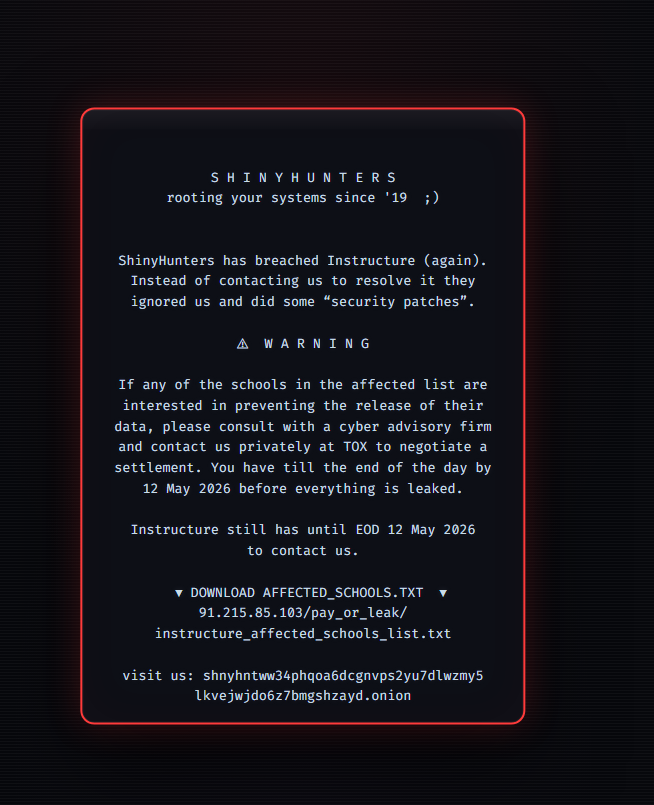
The defacement screenshot above appeared on Canvas login pages at multiple institutions simultaneously. It includes a bulk download link for an affected-schools list, a TOR address for ransom negotiation, and a May 12 deadline. Instructure's CISO Steve Proud confirmed the breach on May 1.
What has not been disclosed is the technical vulnerability. Some reports describe it as a supply chain attack. Instructure has not confirmed that characterization. We do not know the exploit path, the initial access vector for this specific incident, or the internal architecture decisions that shaped the blast radius.
That matters. The analysis below is grounded in what the defacement and public reporting tell us, but the root cause remains Instructure's to disclose.
What the defacement scope suggests
Login pages were modified across many institutions simultaneously. In most multi-tenant SaaS platforms, the login page is served from shared infrastructure: a centralized deployment pipeline, a CDN, or a common application layer. If the defacement reached all customers through a single change, that would suggest access to something above the individual tenant boundary.
This is inference, not confirmation. It is possible the defacement was deployed through a different mechanism entirely. But the observable evidence is consistent with access to a shared infrastructure component.
The trust model at scale
When a university adopts Canvas, it delegates storage, authentication, availability, and the student-facing UI to Instructure. The school's security posture for those functions becomes Instructure's security posture. This is standard multi-tenant SaaS, and when it works, the economics are compelling. One security team patches one platform for thousands of customers.
The tradeoff surfaces in failure. If a breach at the vendor level reaches all customers simultaneously, there is no per-tenant circuit breaker. The blast radius is not one school. It is every school on the platform, at the same time. Whether that is what happened here depends on details Instructure has not yet shared, but the scope of the defacement and the reported record count are consistent with that pattern.
Timing and availability
Canvas went into maintenance mode on May 7, during finals week at most US universities and K-12 districts. Students lost access to assignments, submission portals, gradebooks, and communication channels at the moment those tools were most critical.
Timing a disruption for maximum operational pressure is standard extortion playbook. It works because schools depending on a single LMS platform have no fallback. Canvas down means the workflow stops. There is no degraded mode for thousands of institutions to switch to in a week.
Questions worth asking your vendors
This breach does not tell us exactly what Instructure got wrong. That disclosure may come, or it may not. But it surfaces questions that any organization depending on a multi-tenant platform for sensitive data should be asking.
Tenant-level encryption boundaries. Does the vendor use per-tenant key hierarchies, or does a platform-level breach decrypt all customer data? The difference between ciphertext and plaintext in the attacker's hands is the difference between a breach notification and a FERPA event.
Deployment pipeline integrity. Can a single compromised credential push changes to every customer simultaneously? If so, the deployment pipeline is the actual trust boundary. MFA on deploy, code-review gates, and canary rollouts limit blast radius.
Control-plane segmentation. Does the management plane that provisions tenants and serves the login experience share credentials or network paths with the data plane that holds student records? These are architecturally different trust domains, even when they run in the same cloud account.
Incident response track record. ShinyHunters breached Instructure in September 2025 through social engineering. Eight months later, they breached Instructure again. A second breach by the same group is the most relevant signal available about a vendor's remediation posture.
Where this stands
Named institutions include Harvard, MIT, Oxford, UC Berkeley, Duke, Rutgers, and the University of Michigan, among many others. Multiple institutions have issued independent security alerts. Attorneys are investigating a potential class action on behalf of affected Canvas users. The ransom deadline is May 12.
Instructure revoked privileged credentials and access tokens, deployed security patches, and heightened monitoring across all platforms. Whether any ransom has been paid by Instructure or by individual institutions is unknown.
Two breaches by the same group in eight months. Confirmed exposure of student PII and private messages across thousands of institutions. A platform outage during finals week. These are the facts. The deeper architecture questions are worth asking, but the answers belong to Instructure.